


Artificial Intelligence (AI) has moved quickly from a futuristic concept to a key player in business strategies in all industries. However, the path to successful AI adoption is not straightforward. Many organizations find themselves grappling with questions about where to start and struggle to scale. For businesses aiming to integrate AI, understanding the stages of adoption is crucial. It helps them make informed decisions that align with their goals.
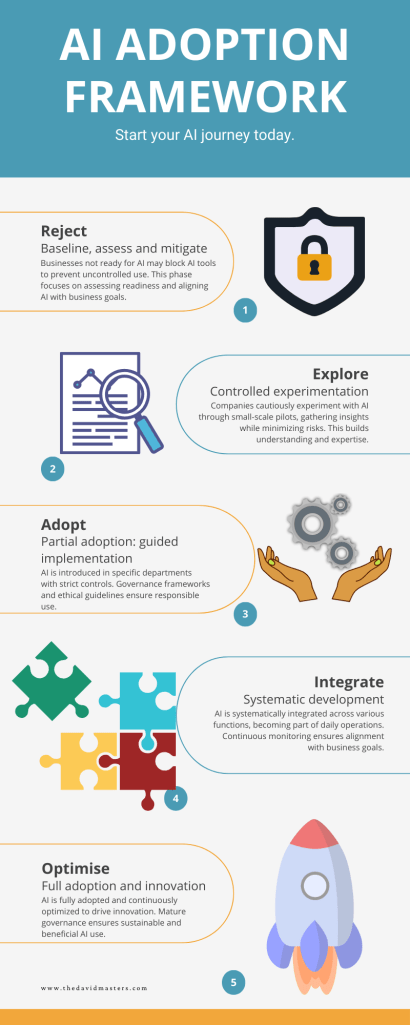
In this blog, I’ll outline my framework for AI adoption, breaking down the process into five stages. Each stage represents a phase of maturity, offering insights into how businesses can gradually embrace AI in a manageable and strategic way.
1. Rejection: Blocking and Assessing
The first stage in AI adoption might seem counterintuitive—actively rejecting AI. However, for many organizations, this is a necessary phase. Not every company is ready to embrace AI, and that’s okay. It’s expensive both in terms of time and money ‘failing fast’ which a lot of businesses simply aren’t set up to do. In this phase, businesses take steps to block or limit access to AI tools and platforms. This isn’t about avoiding AI out of fear but ensuring that the organization isn’t prematurely exposed to risks part of uncontrolled AI usage. This phase is temporary and about waiting for a clear, low-risk, low-cost adoption route to show itself.
Companies in this phase are focused on understanding AI’s relevance to their own business. They’re assessing whether they already have the necessary infrastructure, data quality, and expertise to make AI work effectively.
It is important to reiterate this period of rejection isn’t permanent but a precautionary measure. Its purpose is to give the organization time to build a foundation before introducing AI tools and technologies. Taking the time to assess readiness, companies can avoid the pitfalls of hasty adoption, and avoid significant risk of financial losses, ethical dilemmas, or data security issues.
2. Exploration: Controlled Experimentation
Once an organization has determined that AI could be beneficial and wants to progress their AI adoption, the next step is controlled experimentation. This phase is normally triggered immediately after the securing of their estate in the Reject phase.
In this phase, businesses start to explore AI by creating proof of concepts and run small pilot projects. These activities allow companies to experiment with AI applications in low-risk areas, where the impact of potential failures is minimal.
For example, a company work with a partner to deploy a simple AI tool such as a Microsofts Copilot chatbots to automate a basic customer service contact. The goal at this stage is not to revolutionize the entire business but to start small, gather data, and learn from the results. These experiments help organizations understand how AI can be integrated into their processes, what challenges might arise, and how to overcome them. It also gives early insight to the potential cost and complexity of future projects.
During this phase, it’s crucial to involve stakeholders, including IT, legal, and compliance teams, to ensure that any AI implementation aligns with the broader business strategy and regulatory requirements. By taking a cautious, experimental approach, businesses can build a foundation of knowledge and expertise that will be invaluable in later stages.
3. Partial Adoption: Guided Implementation
After successful experimentation, the next step is to move into partial adoption. Here, AI is introduced into specific departments or functions where it can give clear value. This stage is characterized by guided implementation, where AI tools are deployed under strict control and oversight.
For instance, a manufacturing company might introduce AI-driven predictive maintenance systems to improve equipment uptime, while a retail business might use AI to enhance inventory management and demand forecasting. The key in this phase is to implement AI in areas where the benefits are clear and the risks are manageable so automation may is often not considered suitable at this point.
Guided implementation requires robust governance frameworks to ensure AI is used responsibly and ethically. This includes developing policies on data usage, addressing potential biases in AI models, and setting up mechanisms for human oversight. Training and educating staff on how to interact with AI systems is essential and helps smooth the transition, encouraging acceptance of AI technologies.
The partial adoption stage allows companies to see tangible benefits from AI while still maintaining control by keeping humans firmly in control of all actions. It also provides an opportunity to fine-tune AI tools and processes before scaling them across the organization.
4. Integration: Systematic Deployment
Once a company has successfully implemented AI as an aid in specific areas, the next phase is broader integration. This stage involves systematically deploying AI across various functions and making it a core part of the business’s operations. At this point, AI is no longer an isolated tool but an integral part of how the company operates. Automation may be appropriate here, so creation of related audit, security and controls is essential.
For example, an enterprise might integrate AI into its customer relationship management (CRM) systems to enhance personalization, use AI for advanced data analytics across multiple departments, or deploy AI-powered automation to streamline supply chain operations. The focus here is on ensuring that AI systems are interoperable with existing IT infrastructure and that they contribute to achieving broader business objectives.
During this stage, continuous monitoring and improvement become crucial. Businesses need to track AI performance, measure outcomes, and make adjustments as needed. Regular audits and reviews help make sure that AI systems stay aligned with ethical guidelines, regulatory requirements, and business goals.
The integration phase is about scaling AI in a way that maximizes its potential while maintaining control and oversight. It’s about moving from isolated AI successes to a cohesive strategy that drives efficiency, innovation, and growth across the entire organization. Visibility and engagement with this across the business is critical to ensuring that cohesion occurs and is a positive force within the business.
5. Optimization: Full Adoption and Innovation
The final phase of AI adoption is optimization. AI is fully embedded in the business, and the focus shifts to maximizing its impact for everyone. Now, AI is not just a tool for achieving specific tasks but a driver of innovation and competitive advantage.
In the optimization phase, businesses continually refine and improve their AI systems. This might involve using machine learning to improve process outcomes in real-time. It could also mean developing new AI-driven products or services. Another possibility is leveraging AI to explore new business models. The options are limitless in this phase. The organization’s culture evolves to embrace AI as a core component of its strategy, with employees at all levels contributing to and benefiting from AI-driven insights and capabilities.
Optimization also involves staying ahead of the curve by adopting emerging AI technologies and techniques. This could include exploring the potential of advanced AI models like generative AI. Another approach could be integrating AI with other technologies like the Internet of Things (IoT). Additionally, expanding AI capabilities through partnerships and collaborations is essential.
In this stage, governance and ethical considerations remain paramount. As AI becomes more pervasive, the risks associated with its use can also increase. Businesses must continue to uphold high standards of transparency, fairness, and accountability. This ensures that AI contributes positively to society and the business.
Summary
AI adoption is a journey that requires careful planning, experimentation, and scaling. The framework outlined here—Rejection, Exploration, Partial Adoption, Integration, and Optimization—provides a structured approach for businesses to navigate this journey. By understanding and progressing through these stages, organizations can ensure that they harness the power of AI effectively, responsibly, and sustainably.
This framework is not a one-size-fits-all solution but a guide that can be adapted to the unique needs and circumstances of each business. The key is to approach AI adoption thoughtfully, with a focus on long-term value rather than short-term gains. As AI continues to evolve, businesses that follow a structured approach to adoption will be well-positioned to leverage its full potential and stay ahead in an increasingly competitive landscape.

 Masters Development